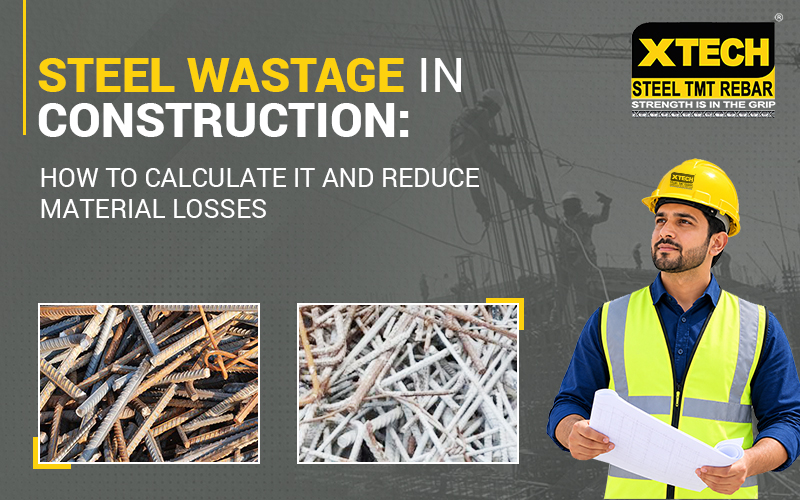
Steel Wastage in Construction: How to Calculate It and Reduce Material Losses
Steel is one of the most important materials in reinforced concrete construction. From foundations and columns to beams and slabs, TMT bars provide the reinforcement that helps structures withstand loads and stresses.
However, not every kilogram of steel purchased ends up in the finished structure. Cutting offcuts, incorrect measurements, fabrication errors, poor material planning and careless handling can all contribute to steel wastage.
For builders and contractors, managing this wastage is not just about saving material. It also helps control project costs, improve site efficiency and make better use of resources.
So, how do you calculate steel wastage, and what can you do to reduce it?
What Is Steel Wastage in Construction?
Steel wastage refers to the portion of reinforcement steel that is purchased or issued for a project but is not incorporated into the structure or otherwise accounted for as reusable material.
Common examples include:
· Short offcuts that cannot be reused.
· Bars cut to incorrect lengths.
· Steel damaged during handling or fabrication.
· Material lost through poor storage and site management.
· Rework caused by incorrect measurements or changes to drawings.
· Unaccounted-for material during inventory and stock reconciliation.
It is important to distinguish between unusable waste and reusable offcuts. Short pieces that can be used for other approved reinforcement requirements should be recorded separately rather than automatically counted as waste.
How to Calculate Steel Wastage Percentage
The simplest way to monitor steel wastage is to compare the quantity of steel lost with the total quantity issued for the work.
Steel wastage percentage = (Unusable steel waste ÷ Total steel issued) × 100
For example, suppose a construction site issues 10,000 kg of reinforcement steel for a particular stage of work. After fabrication and installation, the site records 300 kg of unusable steel waste.
The calculation is:
Steel wastage = (300 ÷ 10,000) × 100
Steel wastage = 3%
This means that 3% of the steel issued for that work has become unusable waste.
For accurate monitoring, the site team should record the steel received, the steel issued, the reinforcement incorporated into the structure, reusable offcuts, returned material and unusable scrap. This helps avoid counting the same material twice or treating reusable pieces as losses.
What Is an Acceptable Steel Wastage Percentage?
The acceptable amount of wastage depends on the project, reinforcement layout, cutting requirements, procurement method and contract specifications.
A preliminary estimating allowance of around 3–5% is commonly used for some reinforcement work, but this should not be treated as a universal standard. Actual wastage can be lower or higher depending on site practices and the nature of the project.
The objective should be to minimise avoidable waste while meeting the approved structural drawings, specifications and safety requirements.
Rather than relying on a fixed percentage alone, builders should measure actual wastage and compare it with the allowance specified for their project.
7 Common Causes of Steel Wastage at Construction Sites
1. Improper Cutting and Measurement
Cutting TMT bars without checking the required lengths can result in offcuts that are too short for other applications.
Even small measurement errors can accumulate across hundreds of bars, increasing material losses and the need for additional purchases.
2. Lack of a Proper Bar Bending Schedule
A bar bending schedule (BBS) lists the reinforcement required for a structure, including bar diameter, shape, cutting length, quantity and weight.
Without a well-prepared BBS, workers may cut bars individually without considering how multiple required lengths can be obtained from standard stock bars.
3. Frequent Changes to Construction Drawings
Changes to structural drawings after steel has been cut or bent can leave prepared reinforcement unsuitable for its intended location.
This can result in unnecessary rework, discarded pieces and additional material costs.
4. Poor Storage and Handling
Steel stored directly on the ground or exposed to standing water and contaminants may require additional inspection and, in some cases, replacement if significant deterioration occurs.
Careless unloading, dragging bars and unstable stacking can also cause physical damage or make material difficult to track.
5. Inadequate Site Supervision
When cutting, bending and material distribution are not monitored, workers may use incorrect lengths, produce avoidable offcuts or lose track of leftover steel.
6. Poor Planning of Material Requirements
Ordering steel without a reliable quantity estimate can create excess stock, unnecessary handling and longer storage periods. Under-ordering, on the other hand, can lead to rushed procurement and fabrication.
7. Practical Ways to Reduce Steel Wastage
Reducing steel wastage requires coordination between procurement, engineering, fabrication and site management.
Here are seven practices that can help:
1. Prepare accurate quantity estimates. Calculate reinforcement requirements using approved structural drawings and the bar bending schedule.
2. Optimise cutting patterns. Plan how different required lengths can be cut from standard stock bars while minimising unusable offcuts.
3. Reuse suitable offcuts. Keep reusable pieces identified and organised. Reuse them only where they meet the approved design requirements and are suitable for the intended application.
4. Maintain proper storage. Protect steel from unnecessary exposure to water, soil and contaminants, and prevent physical damage during handling.
5. Train workers in fabrication practices. Accurate measuring, marking, cutting and bending help reduce errors and avoidable material losses.
6. Track material movement. Record deliveries, stock issued, reinforcement installed, reusable leftovers and scrap. Regular reconciliation makes unexplained differences easier to identify.
7. Coordinate work before fabrication. Confirm drawings, dimensions and reinforcement requirements before cutting and bending begin. This reduces the risk of rework caused by late changes.
How Better Planning Helps Control Construction Costs
Steel wastage has a direct financial impact because wasted material has already been purchased, transported and handled.
Consider a project that uses 10,000 kg of steel at an illustrative purchase price of ₹60 per kg.
· Total steel purchase value: ₹6,00,000
· At 5% wastage: 500 kg
· At 3% wastage: 300 kg
· Difference: 200 kg, worth ₹12,000 at the assumed purchase price
This example illustrates the potential material savings from reducing wastage by two percentage points. It excludes any recovery value from scrap and other costs, such as labour, transport or replacement purchases.
The actual savings will depend on the project's steel quantity, purchase price and wastage management.
Over multiple construction stages, accurate planning and consistent tracking can help prevent avoidable expenses from accumulating.
Choosing Quality TMT Bars Matters Too
Reducing steel wastage begins with good planning, but the quality and consistency of reinforcement steel also matter.
At XTech TMT, we manufacture Fe 500 and Fe 500D TMT bars in diameters ranging from 6 mm to 32 mm, using German Thermex quenching technology. Our bars feature a Double X-Rib design to support bonding with concrete and are produced with attention to manufacturing quality and performance.
For builders across Northeast India, selecting the appropriate reinforcement grade and diameter is an important part of construction planning. The final selection should always follow the structural engineer's specifications.
Quality steel, combined with accurate estimation, careful fabrication and proper site management, supports more efficient construction.
Planning your next construction project? Choose XTech TMT for quality reinforcement steel engineered for strength and reliability.
🌐 Website: https://www.xtechtmt.com/
📞 Call: 91 70990 77676
📧 Email: info@kdindia.com
XTech TMT — Engineered for Strength. Built for Trust.